It’s always possible to be kind

“What wisdom can you find that is greater than kindness?” – Jean-Jacques Rousseau


Leadership is always a hot subject. We often hear people talking about what kind of leadership is best.

There’s no simple answer to that question. Different situations need different leadership. And in fact, even if we would all agree that authenticity is an effective way of leading, there’s not just one way of doing that either.

Great leaders are able to adjust their style based on the situation and the people involved. Great leaders consider the long-term effects of their actions, responses and behaviours.

Kindness as a leadership quality is often underrated. It’s sometimes seen as a weakness to be kind. Nothing could be further from the truth.

Kindness means you are able to understand the other person(s) and you treat them in a way that doesn’t hurt them. This is a strength. This is how you can have real impact.

One such example could be to give someone feedback (positive or constructive), as it would be unkindnot to share something that is holding someone back or could make them even more effective and successful. So don’t mistake kindness for weakness.

“I’m a big believer in acts of kindness, no matter how small.” – Liam Neeson

It’s always possible to be kind – while still being dynamic, driven, creative, empowering or any other quality that a leader may have.

What act of kindness could you perform today? And what impact will that have?

Please share your act of kindness or your thoughts on this subject below.

We will give away a free 1-hour coaching session to two randomly picked responders – will it be you?


About the authors

Mandy Flint & Elisabet Vinberg Hearn, award-winning authors of ‘The Team Formula’.

Their latest book, multi-award-winning “Leading Teams – 10 Challenges: 10 Solutions”, published by Financial Times International is a practical tool for building winning teams. You can download a free chapter of the book at www.leadingteamsbook.com

Praise for ‘Leading Teams’: “Enjoyable to read. Simple to understand. Practical to implement. A must read for team members or leaders” – Debbie Fogel-Monnissen, Executive Vice President, International Markets Finance Officer, Mastercard, NY, USA.

Your impact: Self-PR or not self-PR?

From WeAreTheCity’s Future Leader’s Blog


Continuing on from last week’s blog on how to create impact for the future through your Leadership Brand, let’s turn to a question that leaders often pose to us:
Is it really OK to “promote” myself? I don’t feel comfortable blowing my own trumpet….

It’s all about the value you bring to others.

The quick answer is yes. But the trick is of course in how you do it. As mentioned last week, it’s all about the value you bring to others. You are not really promoting you, you are promoting what you can do for others; the ideas you have, how you can solve their problems, how you can answer their questions, how you can make their lives easier. This is what’s important. And once you look at it this way, you also realise that it’s in fact a good thing to promote those things, for the value of others.

The art to self-PR is about being authentic in the way that you do it;

doing it in your own way, in your own style.

The art to self-PR is about being authentic in the way that you do it; doing it in your own way, in your own style. If you are not a “rah-rah” person then it will not feel right to do it in a “rah-rah” way. Think also about how you influence others through your authentic value-add, as this can help you create your own “walking ambassadors” doing the PR for you, with you.

Here are some more practical recommendations for getting your respectful self-PR underway:

  • Have a clear identity, brand – know your impact
  • Decide who you want to reach, and why
  • Think about building relationship and reputation over time
  • Be consistent and authentic
  • Do you know anyone who is good at self-PR? What do they do? What can you learn from them?
  • Think about what others need, what is it that you can do for them? How could you (further) use self-PR? In what situations and with whom? Who needs what you can offer?
  • Promote ideas and solutions, not accomplishments. What ideas and solutions could you promote? (and who would benefit?)
  • Actions speak louder than words – what do you want the world to see?
  • Evaluate your ideas for self-PR and decide on two specific actions you can take within the next couple of months.
  • Take action! While remembering that all transformational change and impact happens on a behavioural level. It’s not just what you do, but more importantly how you do it that will make the difference.

Yes, in order to have the impact you want and the organisation needs, you may need to make other people aware of who you are and what you’ve got to offer. Remember to use your ULP’s, your Unique Leadership Points in how you do it. Because there is only one you.


About the authors

Mandy Flint and Elisabet Vinberg Hearn, award-winning authors of ”The Team Formula”.

Their latest book, multi-award-winning “Leading Teams – 10 Challenges: 10 Solutions”, published by Financial Times International is a practical tool for building winning teams. You can download a free chapter of the book at www.leadingteamsbook.com

Praise for Leading Teams: “Enjoyable to read. Simple to understand. Practical to implement. A must read for team members or leaders” – Debbie Fogel-Monnissen, Executive Vice President, International Markets Finance Officer, Mastercard, NY, USA.

Your future leadership brand and impact

From WeAreTheCity’s Future Leader’s Blog


We were very happy to be part of WeAreTheCity’s WeAreFutureLeaders conference last Friday in London – where we spoke on this subject.

Whether you could join us or not, here are some ideas on how you can be proactive about your Leadership Impact for the future, by harnessing your Leadership Brand.

A strong, authentic brand can be a great door opener to opportunities now and in the future

So, let’s get started.

How aware are you of your brand? Yes, we all have a personal brand and a strong, authentic brand can be a great door opener to opportunities now and in the future.

In general you could say that a brand is a concept, an expectation, which lives in the head of the customer. As such, the brand is made up by the product itself, the service that surrounds it and the communication that’s used about it.

When all these things are added together, an experience is created, a promise of what the customer can expect, which can be called a brand promise. And as a person, as a leader you have both a brand and a brand promise.

Your brand is made up by your unique strengths, expertise as well as your actions and behaviours.

What does your brand promise? What do people expect for you to deliver? What previous experience have they had with you? Will they expect you to be dependable, creative or optimistic for example? What is your brand all about? What words describe you?

Just like an organisation thinks about its brand, we recommend you do the same as a leader. Take control of your leadership brand to set you up well for the future. If you haven’t yet thought about it, here are some questions to start you working on it:

  • What do other people see/experience when they meet you? If you don’t know, ask for feedforward (feedback that drives you forward).
  • What do you want to be known for? What will be your Leadership Legacy? (particularly important if you are currently seen in a way that you don’t like) And how will you make sure that people know that? How will you show it?
  • What’s your expertise?
  • What are your strengths?
  • What’s your brand promise? What can people expect when they meet you? Create your own tagline – and keep this in your mind at all times to really live that promise. For example: I’m a creative, open-minded leader. I’m a dependable, inclusive leader. I’m an empathetic and driven leader. Act as if you are already there, as this is a great enabler to create the mindset you’re after.
  • How can you respectfully promote yourself, your brand? Keep in mind that self promotion only works really well if it’s done from a point of “the value I bring to others”

Think about it like this: Whether you choose to pay attention to it or not, you have a brand and a reputation. You will have much greater and positive impact if you take control of it and decide what you want to be known for – and then act and behave accordingly.

Tap into your ULP’s – your Unique Leadership Points!

So go ahead, start creating your Future Leadership Brand, reputation and Impact right now. There’s only one you – make your impact powerful through authenticity and strengths. Tap into your ULP’s – your Unique Leadership Points!


About the authors


Mandy Flint & Elisabet Vinberg Hearn, award-winning authors of “The Team Formula”.

Their latest book, multi-award-winning “Leading Teams – 10 Challenges: 10 Solutions”, published by Financial Times International is a practical tool for building winning teams. You can download a free chapter of the book at www.leadingteamsbook.com

Praise for “Leading Teams”. “Enjoyable to read. Simple to understand. Practical to implement. A must read for team members or leaders.” – Debbie Fogel-Monnissen, Executive Vice President, International Markets Finance Officer, Mastercard, NY, USA.

Feedforward: Do you give enough?

This is a sad figure, but not a surprising one. There’s not enough feedback in the workplace, this is a known fact. And yet it is the fuel that can energise performance big time.

“Feedback is the breakfast of champions”

Ken Blanchard

Do you give enough feedback? According to another study by Gallup, getting feedback EVERY WEEK is a major engagement factor for people.

Many leaders we meet will admit to not being that regular in their feedback. Other things get in the way. Urgent issues need sorting. Fires to put out. Meetings to go to. The list of things to do as a leader is long.

Any yet it is so important. There’s nothing quite like knowing that someone has seen your good work and value what you do – yes, we all need feedback.

What can you do to give more regular – and useful, specific feedback? And to whom?

In fact, feedback is more like feedforward – it feeds people so they can move forward. So who can you feedforward today?

About the authors

Mandy Flint & Elisabet Vinberg Hearn, award-winning authors of ”The Team Formula”.

Their latest book, multi-award-winning ”Leading Teams – 10 Challenges: 10 Solutions”, published by Financial Times International is a practical tool for building winning teams. You can download a free chapter of the book at www.leadingteamsbook.com

Praise for ”Leading Teams: ”Enjoyable to read. Simple to understand. Practical to implement. A must read for team members or leadersDebbie Fogel-Monnissen, Executive Vice President, International Markets Finance Officer, Mastercard, NY, USA

A reputation, we all have one?

From WeAreTheCity’s Future Leader’s Blog


It takes many good deeds to build a good reputation and only one bad one to lose it – Benjamin Franklin

Individuals, teams and organisations all have reputations. And reputation is created over time, through words, actions and behaviours. But it’s not set in stone – a reputation can quickly be tarnished and even ruined. A reputation should not be taken for granted. In fact, it should be taken very, very seriosuly. It takes us a long time; years, months, even decades to build one and it can change in a moment.

We can have a good, strong reputation and then after a few behaviours that make others feel uncomfortable, we can lose that reputation and trust. And it takes a long time to recover that trust. We all have our own reputation – in teams, individually or as an organisation. Whether we choose to work on it or not we will have one. It’s therefore highly relevant to ask: What is our reputation? and What do we want it to be? or What does it need to be?

Every single one of us has a reputation, and it will sometimes travel ahead of us either open doors or close doors.

Social media is a great way to keep in touch with clients, business partners and other stakeholders, but needs to be very carefully navigated. A comment, an imprint lasts forever. In that way social media is very honest – we can’t erase our tracks. On the other hand, if we are thoughtful and respectful about it, we shouldn’t have to.

Reputation matters and should be taken seriously.

Do you know what your reputation says about you, your team and your organsiation? If you don’t, find out; ask for feedback. And accept it for what it is, even if it’s not the answer you wanted. Once you know what your reputation is, you can reinforce it, build it or change it. It’s not set in stone, but it can take time and effort to change. It’s worth it though – without a great repuation we will never be able to live up to our full potential.

What reputation are you creating right now? Take control of it.


About the authors

Mandy Flint & Elisabet Vinberg Hearn, award-winning authors of ”The Team Formula”.

Their latest book, multi-award-winning ”Leading Teams – 10 Challenges: 10 Solutions”, published by Financial Times International is a practical tool for building winning teams. You can download a free chapter of the book at www.leadingteamsbook.com

Praise for ”Leading Teams: Finally a proactive approach to team leadership. The genius is that some solutions may seem almost too simple. Very engaging and useful. Christina Skytt, CEO, international bestselling author, Executive Team Coach, Power Goals Academy, Stockholm, Swede

How loud is your body language?

From WeAreTheCity’s Future Leader’s Blog


Do you think a lot about what to say?

Do you carefully choose your words to craft a great question or comment?

Do you think about the message you want to put across to someone else?

We would guess that the answer is yes to most if not all of those questions.


But what about your body language? Do you think about that as much?

diagram

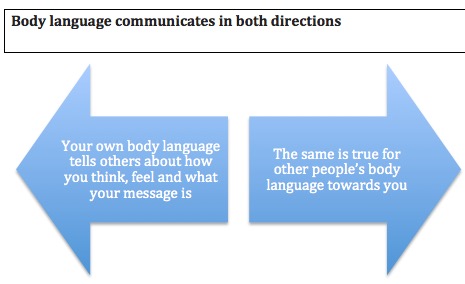
Ultimately your physiology; your body language, your facial expression and your tone of voice will shout much louder than your words.

You’ve probably heard the stats – that words make up only seven per cent of our message, tone of voice 38 per cent and body language a staggering 55 per cent.

With this in mind we probably need to put more focus on body language than words at times, right?

“What you do speaks so loud that I cannot hear what you say”                     

Ralph Waldo Emerson

Here are three simple ways to take control of your body language:

  • Put yourself in a good state of mind – don’t communicate when you are angry for example. Take a deep breath, listen to music that makes you feel good, stretch your legs, get some fresh air.
  • Consider what message you want to convey – and then think about how to match your body to that. If it’s a serious message, how can you look serious without being too stern for example. If you want to put across constructive feedback, how do you do it without looking and sounding aggressive or accusatory.
  • Practice saying what you want to say in the mirror – and watch your body language at the same time. And see how to adjust it. In fact, we’ve found that we do some of our best communication on Skype and similar, as we can see our own body language in the corner of our eye and therefore always keep it in tune and use it appropriately

Communication is your most powerful tool as a leader. Communication can build bridges, form partnerships, promote collaboration and achieve results – and sadly the opposite too.

Your physiology is extremely important and sends all sorts of messages to other people – use it with care to complement rather than drown out your words. And enjoy the results you get.


About the authors

Mandy Flint & Elisabet Vinberg Hearn, award-winning authors of ”The Team Formula”.

Their latest book, multi-award-winning ”Leading Teams – 10 Challenges: 10 Solutions”, published by Financial Times International is a practical tool for building winning teams. You can download a free chapter of the book at www.leadingteamsbook.com

Praise for ”Leading Teams: ”Enjoyable to read. Simple to understand. Practical to implement. A must read for team members or leadersDebbie Fogel-Monnissen, Executive Vice President, International Markets Finance Officer, Mastercard, NY, USA