
Feedforward: Do you give enough?

This is a sad figure, but not a surprising one. There’s not enough feedback in the workplace, this is a known fact. And yet it is the fuel that can energise performance big time.

“Feedback is the breakfast of champions”

Ken Blanchard

Do you give enough feedback? According to another study by Gallup, getting feedback EVERY WEEK is a major engagement factor for people.

Many leaders we meet will admit to not being that regular in their feedback. Other things get in the way. Urgent issues need sorting. Fires to put out. Meetings to go to. The list of things to do as a leader is long.

Any yet it is so important. There’s nothing quite like knowing that someone has seen your good work and value what you do – yes, we all need feedback.

What can you do to give more regular – and useful, specific feedback? And to whom?

In fact, feedback is more like feedforward – it feeds people so they can move forward. So who can you feedforward today?

About the authors

Mandy Flint & Elisabet Vinberg Hearn, award-winning authors of ”The Team Formula”.

Their latest book, multi-award-winning ”Leading Teams – 10 Challenges: 10 Solutions”, published by Financial Times International is a practical tool for building winning teams. You can download a free chapter of the book at www.leadingteamsbook.com

Praise for ”Leading Teams: ”Enjoyable to read. Simple to understand. Practical to implement. A must read for team members or leadersDebbie Fogel-Monnissen, Executive Vice President, International Markets Finance Officer, Mastercard, NY, USA

A reputation, we all have one?

From WeAreTheCity’s Future Leader’s Blog


It takes many good deeds to build a good reputation and only one bad one to lose it – Benjamin Franklin

Individuals, teams and organisations all have reputations. And reputation is created over time, through words, actions and behaviours. But it’s not set in stone – a reputation can quickly be tarnished and even ruined. A reputation should not be taken for granted. In fact, it should be taken very, very seriosuly. It takes us a long time; years, months, even decades to build one and it can change in a moment.

We can have a good, strong reputation and then after a few behaviours that make others feel uncomfortable, we can lose that reputation and trust. And it takes a long time to recover that trust. We all have our own reputation – in teams, individually or as an organisation. Whether we choose to work on it or not we will have one. It’s therefore highly relevant to ask: What is our reputation? and What do we want it to be? or What does it need to be?

Every single one of us has a reputation, and it will sometimes travel ahead of us either open doors or close doors.

Social media is a great way to keep in touch with clients, business partners and other stakeholders, but needs to be very carefully navigated. A comment, an imprint lasts forever. In that way social media is very honest – we can’t erase our tracks. On the other hand, if we are thoughtful and respectful about it, we shouldn’t have to.

Reputation matters and should be taken seriously.

Do you know what your reputation says about you, your team and your organsiation? If you don’t, find out; ask for feedback. And accept it for what it is, even if it’s not the answer you wanted. Once you know what your reputation is, you can reinforce it, build it or change it. It’s not set in stone, but it can take time and effort to change. It’s worth it though – without a great repuation we will never be able to live up to our full potential.

What reputation are you creating right now? Take control of it.


About the authors

Mandy Flint & Elisabet Vinberg Hearn, award-winning authors of ”The Team Formula”.

Their latest book, multi-award-winning ”Leading Teams – 10 Challenges: 10 Solutions”, published by Financial Times International is a practical tool for building winning teams. You can download a free chapter of the book at www.leadingteamsbook.com

Praise for ”Leading Teams: Finally a proactive approach to team leadership. The genius is that some solutions may seem almost too simple. Very engaging and useful. Christina Skytt, CEO, international bestselling author, Executive Team Coach, Power Goals Academy, Stockholm, Swede

How loud is your body language?

From WeAreTheCity’s Future Leader’s Blog


Do you think a lot about what to say?

Do you carefully choose your words to craft a great question or comment?

Do you think about the message you want to put across to someone else?

We would guess that the answer is yes to most if not all of those questions.


But what about your body language? Do you think about that as much?

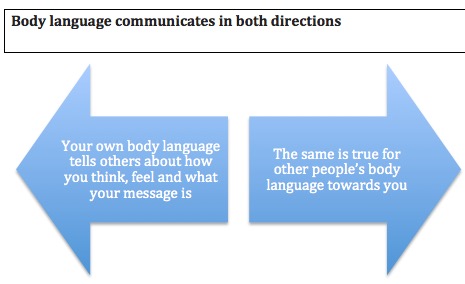
diagram

Ultimately your physiology; your body language, your facial expression and your tone of voice will shout much louder than your words.

You’ve probably heard the stats – that words make up only seven per cent of our message, tone of voice 38 per cent and body language a staggering 55 per cent.

With this in mind we probably need to put more focus on body language than words at times, right?

“What you do speaks so loud that I cannot hear what you say”                     

Ralph Waldo Emerson

Here are three simple ways to take control of your body language:

  • Put yourself in a good state of mind – don’t communicate when you are angry for example. Take a deep breath, listen to music that makes you feel good, stretch your legs, get some fresh air.
  • Consider what message you want to convey – and then think about how to match your body to that. If it’s a serious message, how can you look serious without being too stern for example. If you want to put across constructive feedback, how do you do it without looking and sounding aggressive or accusatory.
  • Practice saying what you want to say in the mirror – and watch your body language at the same time. And see how to adjust it. In fact, we’ve found that we do some of our best communication on Skype and similar, as we can see our own body language in the corner of our eye and therefore always keep it in tune and use it appropriately

Communication is your most powerful tool as a leader. Communication can build bridges, form partnerships, promote collaboration and achieve results – and sadly the opposite too.

Your physiology is extremely important and sends all sorts of messages to other people – use it with care to complement rather than drown out your words. And enjoy the results you get.


About the authors

Mandy Flint & Elisabet Vinberg Hearn, award-winning authors of ”The Team Formula”.

Their latest book, multi-award-winning ”Leading Teams – 10 Challenges: 10 Solutions”, published by Financial Times International is a practical tool for building winning teams. You can download a free chapter of the book at www.leadingteamsbook.com

Praise for ”Leading Teams: ”Enjoyable to read. Simple to understand. Practical to implement. A must read for team members or leadersDebbie Fogel-Monnissen, Executive Vice President, International Markets Finance Officer, Mastercard, NY, USA
Time is not refundable so use it with intention

From WeAreTheCity’s Future Leader’s Blog


“Where did that time go, I can’t believe the first quarter has gone already, can you?”

“I know I saw you in January and it is already April, how did we get to Easter so fast!”

“Is it really 2017 it seems like yesterday when I was saying welcome to 2015”

These phrases sound familiar to you? Everyone we talk to says things like this about time.

Everyone is so busy. With the busy bug people don’t feel like they have a choice, like time is just running away.

With the busy bug people don’t feel like they have a choice, but we all have choices

There are many pressures on us to be busy; there is so much to do, there is the pressure of work, home, family, getting the balance right in our life.

The next job, the next promotion, the next meeting we HAVE to go to, the flight we have to take, the next thing we cannot miss. We get into the busy wheel and it feels like we can’t get off.We feel like we HAVE to, OUGHT to or SHOULD do. There are demands on our time from every angle.

It can feel like we are missing life and great moments when we are in the busy bug mode.

“The bad news is time flies. The good news is you’re the pilot”

Michael Altshuler.

Here are some of our recommendations for how to take the steering wheel when we are busy ‘running’:-

  • Take one step at a time, ensure you stay in the moment. Just take one moment to stop and think. Just one moment to take that breath before you open the door to the meeting or dial into that conference call.
  • Review how much reflection time you are getting, how much downtime to reflect on what has just happened or prepare for that next meeting or next place you have to be.
  • Have you just missed a moment to thank someone, recognise someone or celebrate success? Take that time write that email, say thanks, acknowledge what you have just done before rushing onto the next thing you must do.
  • Be intentional about how you spend your time. Choose to do things you want to do too, not just the things you feel you have to do.

Life is very full for all of us no matter what we do, but life has space too. Grab that space.

Make the most of it as time is not refundable. Enjoy the moment!


About the authors

Mandy Flint & Elisabet Vinberg Hearn, award-winning authors of ”The Team Formula”.

Their latest book, multi-award-winning “Leading Teams – 10 Challenges: 10 Solutions”, published by Financial Times International is a practical tool for building winning teams. You can download a free chapter of the book at www.leadingteamsbook.com

Praise for ”Leading Teams: ”Enjoyable to read. Simple to understand. Practical to implement. A must read for team members or leadersDebbie Fogel-Monnissen, Executive Vice President, International Markets Finance Officer, Mastercard, NY, USA.

The art of making people feel special

From WeAreTheCity’s Future Leader’s Blog


“Wow, that’s a really interesting idea!” Steve looked attentively at Sally.

“I had never thought about that. What made you consider it?”

Sally lit up. “Well, I’ve thought about it for a while and have discussed it with my colleagues recently who also thought the idea had real potential. I’m glad you liked it, do you want to hear some more on how I think it could work in practice?


Steve nodded. “Yes please, that would be really helpful.”

This very short story points at the art of making people feel special.

Because, just like in this conversation, isn’t it wonderful when someone really sees you, hears you, takes interest in what you think, appreciates your input, values your contribution? Simply put, isn’t it great when someone makes you feel special? Of course it is.

We have all been given the ability to make other people feel special.

It’s pretty cool.

We have all been given the ability to make other people feel that way.

And what happens when we do is pretty special – it engages, it makes others want to put that extra effort in, it makes people want to help and support. It’s pretty cool.

Here are some of our key recommendations on how to do it:

  • Be genuinely interested in the other person. Be curious about them. Recognise that everyone has something very unique to contribute (their experience, ideas, knowledge etc)
  • Be 100% present, don’t glance at your phone, don’t think about your next meeting, but really give the person in front of you your full attention.
  • Confirm and praise their input, specifically. Recognise that they have made a unique and valuable contribution.
  • Use the word “and” instead of “but” if disagreeing with what they say. (Eg. “Great idea, and how would that work in practice?” instead of “Great idea, but I don’t think it would work.”) “And” builds bridges. “But” builds walls.

Go on, make someone feel special today!

About the authors

Mandy Flint & Elisabet Vinberg Hearn, award-winning authors of ”The Team Formula”.

Their latest book, multi-award-winning ”Leading Teams – 10 Challenges: 10 Solutions”, published by Financial Times International is a practical tool for building winning teams. You can download a free chapter of the book at www.leadingteamsbook.com

Praise for ”Leading Teams: ”Enjoyable to read. Simple to understand. Practical to implement. A must read for team members or leadersDebbie Fogel-Monnissen, Executive Vice President, International Markets Finance Officer, Mastercard, NY, USA