We were recently inspired by a appearing on Disruptive TV we enjoyed filming a short session about “The Leaders Guide to Impact” published by the Financial Times.
We had such fun drawing on the glass board screen and explaining in more depth about the details in the book.
We all have an impact, every minute every day. Leadership is the act and the art of influencing others so it you have to influence others then you are a leader. This book has something for everyone.
In this clip you can see and hear us talk about the book and the three parts to the book.
Part One – What is Impact? The why and how of achieving Impact
Here we talk about the ripple affect that you can have and how you are a creator of the culture, we all have a responsibility for it.
Part Two – Your impact on your various audiences/stakeholders
In this section we get very specific about the impact you have on your:
Employees, people who work for you
Impact on people more senior that you- your bosses
People at the same level/ your Peers
Your Impact on the board or senior executive/leadership teams
Your external impact on your stakeholders
We explain more about the Executive Presence Sweet spot and creating your stakeholder map.
Part Three – Impact for different desired outcomes
We all have to impact outcomes so in this section we describe how you can create greater outcomes . If you want to create the following outcomes you can follow the roadmap:
Collaborative impact
Change-driving impact
Innovative impact
Business sustainability impact
Great leadership and great teamwork rarely happen by chance. Even the best leaders and the best teams can, with strategic intention and focused effort, become even better – more impactful.
“The Leaders Guide to Impact” is not just a book, it’s a whole impact toolbox.
Mandy Flint & Elisabet Vinberg Hearn, multi-award-winning authors of “Leading Teams – 10 Challenges: 10 Solutions” and ”The Team Formula”.
Their latest book “The Leader’s Guide to Impact” published April 2019 by Financial Times International is an in-depth practical guide to creating the impact you want.
You can download a free chapter of the book at www.2020visionleader.com
Praise for “The Leader’s Guide to Impact” – “If there is one book you read on leadership, this is it. It’s jam-packed with practical tips, stories and frameworks to help you to be the best leader you can possibly be by taking control of your impact on those around you. Elisabet and Mandy hit the leadership nail on the head every time! I wish this book was around 20 years ago!” Vanessa Vallely, OBE, Managing Director, WeAreTheCity, author, “Heels of Steel”
Gone are the days when people could hold on to information, thinking that ”knowledge is power”.
The speed of change means that unhelpful, competitive thinking is no longer desirable nor sensible. The era of openness and even more transparency is upon us.
Any organisation that wants to raise levels of innovation and change progression needs to proactively get their employees communicating better, generously sharing what they know, their expertise, insights and experience, as well as their ideas.
However, if there is no culture of sharing, changing this can take some time. So, there’s not time to wait, get the ball rolling if you want to increase innovation in your organisation.
Here are some tangible strategies to get employees to share what they know:
Be a role model – share what you know
If you’re the leader, make sure you are a role model for what you want others to do. In this case it means you need to be the one who starts sharing. This could for example mean that in team meetings you share observations you have made about competitors, industry trends or ideas you have for how you could change the way you do something as a team. As a team member you can also do this, you don’t have to be the leader to share. As a team member you can also become a role model, sharing can make you a kind of “informal” leader – as leadership is the act and art of influencing others.
Praise and recognise people who share
Notice when people share, thank them and make the connection between their sharing and what it has led to or could lead to. For example: “Thanks for sharing. Now that we all know what competitor X is doing, we can have a creative discussion about how we meet that competitive challenge”. If you reward this behaviour then you will see the ripple effect of the sharing continuing and spreading.
Host a “PODSÔ”
Make sharing easy by holding specific sharing events. We call these “PODS™” (Power Of Dynamic Sharing). Do you need to know what people know/think about a specific subject? Then invite them to an hour or two of dynamic sharing on that particular subject. These are the high-level steps involved:
Decide what you want to achieve by running a PODS™
Invite the people who can have relevant input (keeping in mind that there may be people who may at first seem remote to the subject, but could still give valuable input based on their role, experience or expertise) These can often be the people who have the most innovative ideas.
Prepare for the session by creating a series of very open questions that can draw out answers or trigger discussion as needed
In the session, reiterate the purpose and what people are expected to do (ie. “you are here to share your knowledge on subject X”)
Gather as much information as you can, if possible, captured on flipcharts so the groups can see the output and keep building on the discussion if relevant.
Draw any conclusions that are needed then and there in the meeting – and communicate next steps (ie “I will now use your input for this….”)
Use the new information you have gained about the subject – and keep the relevant people (including those who contributed) informed of progress.
Make links to the big picture
Talk to your team about how you all contribute to the overall vision of the organisation, and how sharing information with each other helps fulfil the team’s purpose and contribution to the bigger picture.
The most important reason why team members need to generously share what they know is that EVERYONE knows something that the others don’t. Don’t waste this opportunity for growth and success! What could you share today?
Over the last two blog posts we have explored the subject of Leadership impact, how Leadership = Impact = Culture as leadership is very contagious.
If you haven’t read them, check them out before you continue reading. Thanks!
This week we want to turn our attention to Executive Presence and how it plays a part of the impact you have.
Executive presence is a combination of behaviours, skills and style, and can sometimes be described as the ability to command a room (sometimes completely without saying or doing anything). Effective executive presence can look different in different leaders. Some exude it, regardless of what position they have. So what is it? How would you describe it? And how do you get it and develop it, if it’s not already there?
Exuding Executive Presence
We were recently in a situation with 50 leaders in a room where a senior leader was joining us, whom we had not previously met. As soon as she entered the room, we could tell it was her by the way she strode in, confidently, her eyes were scanning the room, smiling, nodding and acknowledging people’s presence, indicating that she had seen them and would get to them. She moved easily to her seat and started a conversation with the people at that table; interested, engaged. The way people reacted when she arrived, confirmed who she was to us. They turned their attention towards her, almost straightening their posture in their chairs, and clearly signaling that they knew she was there. Some were even getting up and walking up to her, extending a hand, hence demanding her attention. Others sat back but their radar was still on with regards to where she was. She became the focus of attention, whether she wanted it or not.
Even if she had not had executive presence, she would have attracted their attention because of her position. There’s always positional presence, dictated by the seniority of the role, but executive presence is about more than a title and hierarchy.
We are talking here about effective executive presence, needed to build relationships and long-term success. Many of us may have experienced not so positive executive presence, where leaders have used their position of power to dominate, instill fear and influence in a manipulative and negative way. In the story above, the senior leader could have had a very different response from people if she had stormed into the room, on her phone, still talking, acting all superior and only wanting to talk to the more senior people for example. It would have made people feel unimportant, not respected and not appreciated. Back in the workplace this would lead to you not wanting to go the extra mile for that leader, so productivity would be negatively affected. There would arguably have been some kind of executive presence but not of the kind that drives trust and sustainable collaborative followership. There’s nothing endearing about dictatorial leadership.
Consider executive presence and gravitas as a key factor to use in order to influence more and more effectively, particularly if you want to influence someone more senior than you. Even if you are not an executive, executive presence is something you will need to develop and use more as you progress your career.
We have been working with and studying leaders and their impact for 22 years and have identified five areas of Executive Presence, made up by a number of behaviours that represent that presence.
The Executive Presence Sweetspot™
Reflect on the five behavioural areas above and how often and consistently you think you display these today and which ones you need to be more intentional about living to deepen your impact and grow as a leader. Which area(s) do you think are most important for you to develop?
The most effective leaders are able to tap into each of these behavioural areas when needed, hence creating an Executive Sweetspot in the middle, where they can have the greatest positive impact.
Executive Presence is a great career builder, if used authentically. That’s when it’s experienced as something great by others, something that creates greater collaboration, more trust, more innovative solutions and better results.
Want to know more about the behaviours that make up the behavioural clusters above? And how to develop those behaviours? Check out chapter six of our new book “The Leader’s Guide to Impact”.
Do you remember the ‘Bad’ and the ‘Good’ Culture Shapers from last week’s Future Leaders’ post?
If not, check it out before you continue reading. Thanks!
The reason leaders are such major culture shapers is that leadership behaviours are contagious. A study by Zenger & Folkman where 51 leadership behaviours were tested for their contagiousness, showed that these are the most contagious behaviours, in order:
Developing self and others
Technical skills
Strategy skills
Consideration and cooperation
Integrity and honesty
Global perspective
Decisiveness
Results focus
Where do you think you are at with these behaviours? What behaviours would you like to make contagious where you work? What behaviours could you develop and display more to shape the kind of culture you want to embed in your team or organisation?
Culture is created through the experiences we spark in others. Some experiences are positive and some negative and it can be describe as making deposits in people’s “positive and negative bank accounts”. For a team to be effective, trustful and collaborative, people need to have 3,5 positive experiences for every 1 negative experience with their colleagues. What this means is that we need to create enough of those positive encounters to make up for the inevitable negatives – and we can probably all do this more; praise others, give credit where credit is due, listen with interest, and recognize strengths.
Next week, we’ll explore the concept that Leadership = Impact = Culture even more by asking the question what Executive Presence is and why it matters to you even if you’re not (yet) an executive.
Until then, have a great week – and more great impact!
Leadership is the act and art of influencing and impacting others.
This means everyone is a leader.
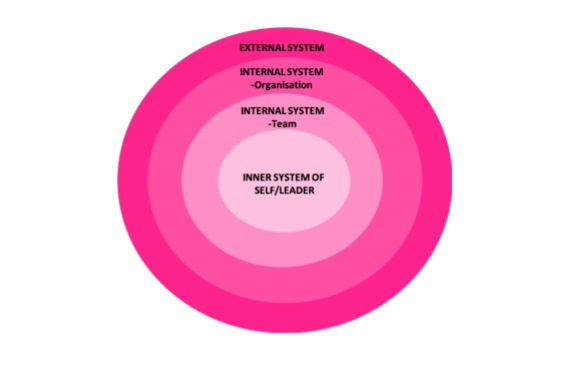
As the picture below shows, the impact you have starts from within. Powerful impact starts with self-leadership; how you think about yourself and how you see yourself becomes what you send out. And that in turn affects what others see and experience – from your team through the organisation and externally too. That’s the ripple effect you have.
You’re a culture shaper. Just like everyone else, you shape the culture of your workplace by what you do, but also by how you are, how you behave. As culture can be described as “how things get done around here”, it includes the daily interactions between people; how we act, react and respond to one another.
Leaders at all levels have a responsibility when it comes to the organisation’s culture, but the buck stops with the CEO and the senior leadership team. Everyone’s behaviours shape the culture, but the behaviours that are displayed by and accepted or even rewarded by leaders are the biggest culture shapers. They impact the culture the most.
The ‘Bad’ culture shaper
Imagine a CEO who speaks about the value of transparency and openness, but who goes behind his/her executives backs, sharing certain things only with his ‘trusted few’. The executives that experience this become cautious, thinking it’s not about transparency at all –
I’d better tread carefully around here from now on. These executives in turn become less transparent with their teams, who become disenchanted by the false behaviours (=not in line with the values) of their leaders. That is how leaders shape culture.
The ‘Good’ culture shaper
Imagine a company that says it values and respects people’s work/life balance. The leaders then reward and praise people who work smarter and within work hours, and who work together in teams to achieve. They are rewarding what they value not what they don’t value (they are not rewarding people who work long hours and sacrifice their personal lives. That is how leaders shape culture.
Culture should be on every board’s, executive team’s and leader’s agenda. Leaders at all levels set the tone for ‘how things get done’. Culture starts at the top but can’t just be dictated from the top. It needs to resonate with people at all levels, as something they would ‘stand for’ themselves.
So leaders who want to maximise the power that is culture, must look to themselves first: How am I behaving? What messages am I sending through my behaviours? What behaviours am I creating in others? And then start changing and adapting their behaviours, creating new habits if needed to create the kind of workplace culture you want to have.
This topic is what we talked about at last week’s WeAreFutureLeaders conference in London – a great event, which we were very happy to be part of!
Next week we’ll continue to explore the concept of how leadership = impact = culture.