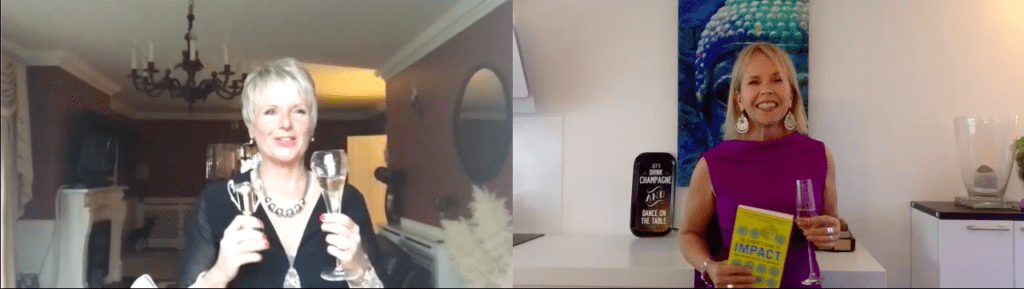
We are so very proud to have received our 7th* book award, Finalist in the Book Excellence Awards’ Leadership category!
This is the first award for our third book “The Leader’s Guide to Impact” published by Financial Times Publishing 2019.
We live in unprecedented times, all around the world. The COVID-19 pandemic is horrific, impacting people and societies everywhere. Our thoughts are with everyone who is affected.
And in all of this, it is important to stay strong, hopeful, resourceful and grateful. Not every day will be brilliant but together we can do a lot to make each day matter, taking it a day at time, finding solutions to the challenges we face.
On Friday evening we enjoyed this virtual book award event. It is particularly important to celebrate at this time, we all need to notice the things to be happy and grateful for. And we, of course, couldn’t do it without Julian and Rich, who have cheered us on from the start.
AND we wanted to share it with you too, as a reminder that we all need to stop and value the good things in life, especially at a time like this.
Cheers! Stay safe and strong! x
*Other awards:
’The Team Formula: A Leadership Tale of a Team who found their Way’, MX Publishing 2013. has received two awards: London Book Festival runner-up & Indie Book Excellence Book Awards Finalist.
‘Leading Teams 10 Challenges 10 Solutions’, FT Publishing 2015, has received 4 awards: Book Excellence Awards Winner, Best Book Awards Finalist, Axiom Business Book Awards Bronze & International Book Awards Finalist
We are very excited and proud to share that our third book “The Leader’s Guide to Impact” has been honoured as a Book Excellence Awards Finalist in the Leadership category.
These Awards honour books that have high quality design, writing and market appeal.
Our purpose with writing leadership books is to support leaders around the world in making the most of their unique leadership style – and that’s why this award is so important to us – it allows us to support more leaders through greater reach.
Thanks for reading and sharing!
You can buy the book in all online bookstores including
Christine wanted to encourage her team’s work/life balance, so she kept telling her team members to not work too late, but instead go home at the end of the working day and spend time with friends, family and on hobbies. The team members were really pleased, they had a very positive reaction to this message and responded by leaving the office shortly after 5 most days.
However, after about a week, they noticed that they had received late evening emails from Christine almost every day. This confused them, as her actions didn’t match what she was saying. Why is she working late while telling us not to? She’s clearly not meaning that we should go home at five. So what else is she meaning or not meaning? Can I trust her?
To top it all off, Christine decided to reward a couple of people who had been working all hours on a project, late at night and into the weekends. Now the team members were really confused.
This short story from ‘The Leader’s Guide to Impact’ (FT Publishing 2019) highlights how easily good intentions become confusing platitudes if not also role modeled. The old expression “walk the talk” still rings true.
Ultimately, people don’t do what we say, they will do what we do. Leadership is contagious.
And as leadership is the act and art of influencing, we are all leaders.
Collective intelligence and collective decision making equals the ability to influence more.
When a a team or leadership team works well together, with a shared purpose that everyone believes in and owns, something almost magical happens – their impact is multiplied, their teams work better with each, communication flows more effectively, goals are aligned and the risk of confusion and overlaps are almost completely eradicated.
So if you are part of a leadership team, or a team, and want to have greater impact together, better goal achievement, then look for the common purpose, what you all have in common. What do you all want to achieve?
And then talk about that and reach agreement on a shared commitment to that purpose. Make that commitment a promise.
Whenever possible, connect your goals to those of your peers. If there are competitive behaviours between you and your peers, then having connected goals will make those competitive behaviours impossible to carry on with. If each team member can be goaled not just on his/her individual performance but also the performance of the team overall, then it brings out collaborative behaviours instead.
“Leadership is not about a title or a designation.
It’s about impact, influence, and inspiration.”
Robin S. Sharma
Want great team or leadership team success? Then get together with your peers and work on how to work together and how to have greater impact together. Create a team success journey plan and start taking steps together. Don’t leave it to chance, take action.
For more info on personal and leadership impact, check out our latest book “The Leader’s Guide to Impact” which serves as an easy-to-follow strategic and practical tool for individual leaders and leadership teams alike.
What can you do, as a team, to make 2020 our best year yet?
Getting a team to work well together doesn’t happen by chance. It requires intention, commitment and a focus on both structure/task and behavioural habits.
The start of the year is a great time to stop for a moment with your team and discuss:
“How do we best work together to best achieve our goals, and make this a truly great place to work? How can we make this year our best year yet?”
One crucial ingredient in that dialogue is to create a Team Charter.
A Team Charter is a document that describes the purpose, framework and agreements of the team. Creating a Team Charter is a shared process (not just a leadership task), hence making it a powerful and visual shared commitment. A Team Charter that is created by everyone, is owned by everyone and therefore is carried out by everyone.
Each Team Charter is unique to the team, but typically it includes at least the 7 steps:
Team purpose and clear links to the organisation’s vision and purpose (how you as a team make a difference)
Expectations and goals (what are you expected to do and achieve this year?)
Roles and responsibilities (who does what, what are the overlaps and collaboration opportunities?)
Skills and expertise needed to fulfil purpose (is there anything new you need to learn and/or how can team members’ skills/expertise be shared?)
Resources needed to fulfil purpose (g.what data and tools do you need to do a great job?)
Operating guidelines: behaviours and how the team will work together to fulfil the purpose (g. how should you treat each other, how should you communicate, help each other, spend time together?)
Signed agreement/commitment
Some seem obvious and almost implicit, don’t they? Well, then ask yourself as a team; why aren’t we doing it then. And if you are doing it, challenge yourself on how you can make it even better, strive for more together. You may have these 7 steps in some implicit form, it is also important to make them explicit for all to agree to openly.
So yes, as you reflect on these 7 steps, some are probably already in place, but it is still crucial to review them as a team to reconfirm or indeed update your shared agreement on those important ingredients of teamwork. The steps that definitely need updating each year, for every team, are 2, 6 and 7.
Once you have documented the team agreements steps 1-6 (and any other topics you have chosen to include as a team), make sure each team member gets invited to sign the document (step 7). Signing the Team Charter agreement signals real commitment and cements it. You can even call it a team promise – after all, a promise feels even more powerful.